
A New GLOBALCIT Citizenship Law Dataset: What, Why and How?
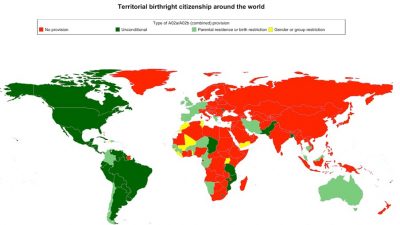
In this blogpost, Luuk van der Baaren and Maarten Vink present the new GLOBALCIT Citizenship Law Dataset and identify major key global trends.
In this blogpost, Luuk van der Baaren and Maarten Vink present the new GLOBALCIT Citizenship Law Dataset and identify major key global trends.

Chile’s 2021 Immigration Law creates a new regulatory and institutional framework for immigration to the country. This blog post explores the implications of Chile’s 2021 Immigration Law for the prevention and elimination of statelessness, nationalisation of resident foreigners, and electoral rights.

In this blog post, Solomon Oseghale Momoh summarises his PhD research on the gaps in the nationality law and policy of Nigeria, with a particular focus on safeguards for people exposed to the risk of statelessness. Momoh emphasises the need to transpose the 1954 Convention Relating to the Status of Stateless Persons into domestic law and, crucially, the need for Nigeria to develop a statelessness determination procedure.

The nationality provisions in the Nationality and Borders Bill, currently progressing through the UK Parliament, are, with one exception, broadly progressive as they aim to rectify historic injustices and discrimination, contrasting with other parts of the Bill, which have been widely condemned. This blog post explains the background to and effects of the nationality clauses.
This blog articles introduces the ISI Global Seminar Series on Citizenship Stripping, which aim to unpack and understand the background of and problems around deprivation of nationality. Each of the Seminars presents a different perspective by key experts on the issue, and is accompanied by a Lecture & Debate Kit.
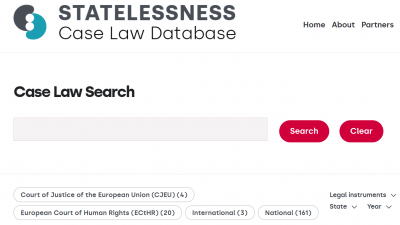
In this blogpost, Chria Nash presents the new Statelessness Case Law Database created by the European Network on Statelessness.

Highlighting a recently published article, we analyse South American and European countries’ governance of human mobility during the pandemic the first half of 2020, its effect on migrants, and how it moved the concepts of borders and citizenship into some uncharted territories.

In the European Union (EU) the issue of citizenship can be brought to the supranational level because the citizenship of EU Member States is also EU citizenship. This provides certain opportunities for engaging the norms and principles of EU law, such as the principle of proportionality. However, ethnic and other nationalisms undermine the application of the principle of proportionality as regards access to and loss of citizenship.

The case of Hubert Howard is illustrative of the broader injustices suffered by members of the ‘Windrush generation’ at the hands of the UK state. A recent decision by the England and Wales High Court offers some (partial) redress.
The ISI Database on Statelessness and Human Rights is a new user-friendly tool that offers easy access to recommendations on statelessness and the right to a nationality, issued within the UN human rights system. This blog explains how it can help to strengthen knowledge of and engagement with human rights standards.