
EUROSTAT: Acquisitions of citizenship slightly declining in the EU

July 8, 2010

(figures and table below the text)

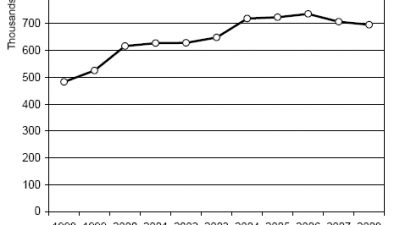
[EUROSTAT] The number of people acquiring citizenship of an EU Member State declined for the second Figure 1: Total acquisitions of citizenship in the consecutive year in 2008 after rising for more EU-27 than eight years. The decline, roughly 2%, was smaller than that recorded for 2007 (aroun 4%). The total number of acquisitions recorded in the EU in 2008 was slightly below 700 000.

The highest number of acquisitions was recorded in France, the United Kingdom and Germany. These three countries accounted for more than 50% of the EU total. While France recorded a moderate increase compared with 2007, the other two countries granted over 20% fewer citizenships in 2008.

Sweden was the country with the highest number of acquisitions per inhabitant in the EU, followed by Luxembourg, FranceUnited Kingdom. Sweden was also the country with the highest number of new citizenships granted in relation to the size of the resident foreign population.

As in most recent years, Moroccans and Turks represented the largest groups among those who became citizens of an EU Member State with 9% and 7% of the EU total respectively.

France, United Kingdom and Germany granted half of all new citizenships in the European Union

For the second consecutive year the total number of acquisitions of citizenship has decreased in the European Union in 2008, to a level slightly below 700 000. This corresponds to a decrease of roughly 2% with respect to the number recorded in 2007, which was 4% lower than for 2006.

Read More …

Moldova: Dual citizens cannot be excluded from public offices. A summary of recent court decisions concerning Moldovan-Romanian dual citizenship

by EUDO CITIZENSHIP expert Viorelia Gasca

July 5, 2010

On April 27, 2010 the Grand Chamber of the European Court of Human Rights issued its judgment on the case Tanase versus Moldova (see the link to full text of judgment), forcing Moldova to lift its ban on dual citizens from holding public posts.

The ECHR argued that the measure was disproportionate with the government’s purpose of ensuring loyalty of its Members of Parliament. This is the final judgment on this case. The previous Chamber judgment on 18 November 2008 established that Moldova had to amend the law that bans holders of dual nationality from holding public posts, including seats as MPs.
Moldova was the only Council of Europe member state that tolerates dual nationality but does not allow dual nationals to hold public office or running for elections (see an earlier EUDO CITIZENSHIP news item on this topic).

On 7 December 2007 the Moldovan Parliament adopted a law on dual nationality, banning individuals with dual nationality from holding public posts.

Shortly afterwards, the lawyer Alexandru Tanase, who himself has double Moldovan and Romanian citizenship, brought the Moldovan government to court arguing that the law violated his right to stand as candidate in free elections and to take his seats in parliament if elected.

Read More …

Hungary: Romanian and Hungarian Ministers of Foreign Affairs discuss Hungarian citizenship law

By EUDO CITIZENSHIP research collaborator Andrei Stavila

19 June 2010

According to Romania’s Minister of Foreign Affairs Teodor Baconschi Romania wants to be sure that the application of Hungary’s new citizenship law respects international agreements as well as ‘the spirit and the letter of international law’.

Baconschi said Hungary’s Minister of Foreign Affairs Janos Martonyi had assured him ‘that Budapest will apply all amendments to the citizenship law in such a manner that discrimination on ethnic grounds and any form of mass acquisition of citizenship will be avoided’, said Baconschi after meeting with his Hungarian counterpart.

Read More …

Lithuania: The Provisional Law on Citizenship Remains in Effect

by EUDO CITIZENSHIP expert Egidijus Kūris

30 June 2010 **UPDATE**

As recently reported on EUDO CITIZENSHIP (see below), the parliamentary vote on the new Law on Citizenship was planned for 29 June 2010. The new Law had to replace the current one which, after two prolongations, is valid until 1 January 2011. It was also expected that, together with the adoption of the new Law, the Seimas (parliament) would refer it to the Constitutional Court to review the constitutionality of some of its provisions, namely those which open widely the doors to multiple citizenship.

However, the citizenship issue (as many others, too) was removed from the agenda of the Seimas due to the fact that on that day the Seimas held a solemn sitting to commemorate the late Algirdas Mykolas Brazauskas, President of Lithuania from 1993 to 1998, who had died three days earlier. So far, the citizenship issue is not included in the agenda of parliamentary sittings for the coming days. It is expected that the Seimas will go into summer recess on 3 July 2010. Thus, the vote on the new law may be held only in the fall session of the Seimas between 10 September and 23 December 2010 (unless an extraordinary session is convened earlier).

Consequently, in the meantime, the current provisional Lithuanian Law on Citizenship remains in effect.

Read More …

Denmark: New rules on access to permanent residence passed in Parliament on 25 May 2010

by EUDO CITIZENSHIP expert Eva Ersbøll


On 26 March 2010 a Bill was presented in ther Danish Parliament proposing comprehensive amendments to the Aliens Act, including a reform of the rules on access to permanent residence. The Bill was enacted two months later, on 25 May. With the amendments to the Aliens Act the requirements on access to permanent residence have been strengthened to a degree that will probably prevent many foreigners from acquiring a permanent residence permit and thus also prevent them from access to citizenship.

The new requirements apply to foreigners who make applications for permanent residence on or after 26 March 2010. According to section 11 of the Aliens Act they must have attained the age of 18 and achieved at least 100 points according to section 11, paragraph 4-6 (70 points must be achieved according to paragraph 4, 15 points according to paragraph 5 and 15 points according to paragraph 6).

Read More …

United Kingdom: 29.1 percent of migrants taking the citizenship test fail

by EUDO CITIZENSHIP expert Helena Wray

Figures released by the British government show that 29.1 percent of migrants who take the ‘Life in the UK’ test fail it.

The test, alongside an English language test, was introduced in 2005 for candidates for naturalisation and extended to most of those acquiring settlement in 2007. All applicants for naturalisation must take the test either at the settlement or the naturalisation stage, unless they are exempt due to age or infirmity.

Failure rates are highly differentiated by nationality. 98 percent of Australians, 97 percent of Americans and 96.9 percent of Canadians who took the test passed it. Other countries where English is widely spoken also fared relatively well with 90.2 percent of Zimbabweans and 82.5 percent of Nigerians passing. However, several nationalities with substantial numbers of migrants in the UK scored less than 50 percent. For example, only 47.9 percent of Iraqis, 47.8 percent of Afghans, 45.9 percent of Turks and 44 percent of Bangladeshis passed. Many Afghans and Iraqis are in the UK as refugees or with subsidiary protection. Although they do not need to pass the test to remain in the UK, their position is more secure after naturalisation. Other migrants, for example spouses or workers, cannot obtain a secure status without passing the test.

Read More …

Latvian Constitutional Court acknowledges the right of the legislature to set deadline for registration as dual citizen

by EUDO CITIZENSHIP expert Kristine Kruma

The Latvian Constitutional Court reaffirmed the validity of the norm in the country’s Transitional Provisions of the Law on Citizenship which provided for holders of dual citizenship acquired during the Nazi and Soviet occupation. According to this norm, individuals who were deported or left Latvia during occupation can keep the second nationality acquired during their time abroad if registered as Latvian citizens before July 1, 1995.

The Senate of the Supreme Court had contested this norm claiming that the registration deadline did not comply with Article 1 (Latvia is an independent democratic republic), and Article 2 (the sovereign power of the State of Latvia is vested in the people of Latvia) of the Constitution, and the doctrine of continuity of the State of Latvia stated in the country’s Declaration of Independence.

Read More …

Montenegro signs the European Convention on Nationality but rejects dual citizenship

by EUDO CITIZENSHIP/CITSEE expert Jelena Džankić

On May 5, 2010, Montenegro signed the European Convention on Nationality. The Convention was promulgated in Strasbourg in November 1997, and provides for non-discrimination in regulating questions of nationality. It attempts to prevent statelessness and regulates multiple nationality.
The signature has been preceded by a Law on Confirming the European Convention on Nationality, adopted on March 2, 2010. The Law enters into force on the eighth day from the date of its publication in the Official Gazette of Montenegro – International Agreements. Pursuant to article 3 of the Law, ‘Montenegro does not accept the implementation of provisions stipulated in article 16 of the Convention’. This reservation clause has its roots in the current Citizenship Act, which does not allow dual citizenship.

Read More …

Hungary: Earlier reports on the citizenship law reform on EUDO CITIZENSHIP

Read a summary of the new provisions in the Hungarian Nationality Act (July 13, 2010)

“Ethnic Hungarians in transborder states may well be the biggest losers and victims of Hungary’s dual citizenship reforms”

by EUDO CITIZENSHIP experts Mária M. Kovács and Szabolcs Pogonyi

24 May 2010

During the past eight years of the socialist-liberal coalition government, the rift between the opposition and the ruling parties grew bitter: it seemed that no consensus on important political questions is possible between the Hungarian governing parties and the opposition. But after the landslide victory of the centre-right Fidesz party in the April parliamentary elections, consensual politics seem to be alive again – at least on some important national issues, primarily on offering citizenship for Hungarians living abroad and the commemoration of the tragic consequences of the 1920 Paris peace treaties. After initial discussions in the Parliament it seems that all major parties support Fidesz’s initiative to offer dual external citizenship for Hungarians living in the neighboring countries, and also endorse the commemoration of the anniversary of the 1920 Paris peace treaties as Hungary’s biggest national catastrophe.

Read More …