Der Spiegel reports on “EU enlargement by stealth” through mass naturalisation offered by Romania

Benjamin Bidder reports for Der Spiegel on Romanian President Basescu’s attempt to increase the country’s population by generously offering hundreds of thousands of Romanian passports to impoverished Moldovans. The Romanian policy allows Moldovans to obtain an EU passport in order to work in Western Europe as cheap labourers.

Read More …

Netherlands: Revision of the Nationality Act

by EUDO CITIZENSHIP Consortium members Gerard-René de Groot and Maarten Vink

An amendment passed in June includes restrictions of multiple citizenship for persons raised in the Netherlands, an acquisition option for latent Dutch citizens, the introduction of double language tests in the Caribbean parts of the Netherlands and withdrawal of citizenship for crimes harming essential interests of the state.

On 16 June 2010 the Upper House of the Dutch parliament agreed to a proposal from the Minister of Justice, Ernst Hirsch Ballin, to amend the Netherlands Nationality Act. The Act of Parliament was signed by the Queen on 17 June 2010 and published in the Official Journal 2010, 242. The revised law will most likely come into force on 1 October 2010 and ends a legislative process that started already in 2005, when former Minister of Justice Rita Verdonk introduced an earlier bill that aimed at the restriction of multiple citizenship and at the withdrawal of Dutch citizenship from persons convicted for crimes harming essential interests of the state. That bill failed to be adopted in the Lower House of Dutch Parliament but was reintroduced, in a revised form, by a new government in 2008.

Read More …

Ukraine: Reactions to the Hungarian Citizenship Law

By EUDO CITIZENSHIP expert Oxana Shevel

12 July 2010

Unlike in neighbouring Slovakia where the May 26 amendment to the law on Hungarian citizenship that granted persons of Hungarian ancestry residing abroad the right to Hungarian citizenship led to a domestic outcry, in Ukraine there has not been any official reaction so far. According to the 2001 census, Hungarians are the 7th largest ethnic group in Ukraine, numbering 156,600. They are concentrated in the Zakarpattia oblast (region) in the south-west corner of the country where they constitute the second largest ethnic group (after Ukrainians), numbering 151,500, or 12 percent of the region’s population. Given that within the region the Hungarians are further concentrated in the districts along the Hungarian border, and that today’s Zakarpattia was part of the Kingdom of Hungary and became part of the Soviet Ukraine only in 1945, one can expect Ukraine to be as sensitive as Slovakia and Romania to the dangers of Hungarian irredentism that some suspect lurking behind the new Hungarian law. The Hungarian law also relates to Ukraine’s long-standing concerns about, and opposition to, the principle of dual citizenship. This opposition stems first and foremost from the Ukrainian elites’ fears that dual citizenship with Russia can endanger Ukraine’s sovereignty and potentially even territorial integrity, given that Ukraine’s ethnic Russians are concentrated in Ukraine’s regions bordering Russia, especially in Crimea where they constitute the majority. Even though there is no dual citizenship agreement between Russia and Ukraine and Ukrainian legislation does not recognize dual citizenship, Russia has been issuing Russian passports to Ukrainian citizens since the 1990s. According to some estimates, as many as 100,000 people in Crimea now hold both Ukrainian and Russian passports.

Read More …

EUROSTAT: Acquisitions of citizenship slightly declining in the EU

July 8, 2010

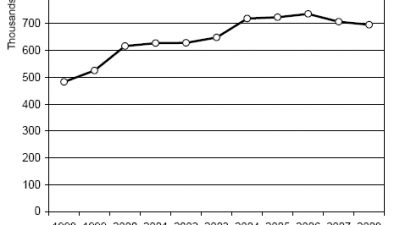
(figures and table below the text)

[EUROSTAT] The number of people acquiring citizenship of an EU Member State declined for the second Figure 1: Total acquisitions of citizenship in the consecutive year in 2008 after rising for more EU-27 than eight years. The decline, roughly 2%, was smaller than that recorded for 2007 (aroun 4%). The total number of acquisitions recorded in the EU in 2008 was slightly below 700 000.

The highest number of acquisitions was recorded in France, the United Kingdom and Germany. These three countries accounted for more than 50% of the EU total. While France recorded a moderate increase compared with 2007, the other two countries granted over 20% fewer citizenships in 2008.

Sweden was the country with the highest number of acquisitions per inhabitant in the EU, followed by Luxembourg, FranceUnited Kingdom. Sweden was also the country with the highest number of new citizenships granted in relation to the size of the resident foreign population.

As in most recent years, Moroccans and Turks represented the largest groups among those who became citizens of an EU Member State with 9% and 7% of the EU total respectively.

France, United Kingdom and Germany granted half of all new citizenships in the European Union

For the second consecutive year the total number of acquisitions of citizenship has decreased in the European Union in 2008, to a level slightly below 700 000. This corresponds to a decrease of roughly 2% with respect to the number recorded in 2007, which was 4% lower than for 2006.

Read More …

Moldova: Dual citizens cannot be excluded from public offices. A summary of recent court decisions concerning Moldovan-Romanian dual citizenship

by EUDO CITIZENSHIP expert Viorelia Gasca

July 5, 2010

On April 27, 2010 the Grand Chamber of the European Court of Human Rights issued its judgment on the case Tanase versus Moldova (see the link to full text of judgment), forcing Moldova to lift its ban on dual citizens from holding public posts.

The ECHR argued that the measure was disproportionate with the government’s purpose of ensuring loyalty of its Members of Parliament. This is the final judgment on this case. The previous Chamber judgment on 18 November 2008 established that Moldova had to amend the law that bans holders of dual nationality from holding public posts, including seats as MPs.
Moldova was the only Council of Europe member state that tolerates dual nationality but does not allow dual nationals to hold public office or running for elections (see an earlier EUDO CITIZENSHIP news item on this topic).

On 7 December 2007 the Moldovan Parliament adopted a law on dual nationality, banning individuals with dual nationality from holding public posts.

Shortly afterwards, the lawyer Alexandru Tanase, who himself has double Moldovan and Romanian citizenship, brought the Moldovan government to court arguing that the law violated his right to stand as candidate in free elections and to take his seats in parliament if elected.

Read More …

Hungary: Romanian and Hungarian Ministers of Foreign Affairs discuss Hungarian citizenship law

By EUDO CITIZENSHIP research collaborator Andrei Stavila

19 June 2010

According to Romania’s Minister of Foreign Affairs Teodor Baconschi Romania wants to be sure that the application of Hungary’s new citizenship law respects international agreements as well as ‘the spirit and the letter of international law’.

Baconschi said Hungary’s Minister of Foreign Affairs Janos Martonyi had assured him ‘that Budapest will apply all amendments to the citizenship law in such a manner that discrimination on ethnic grounds and any form of mass acquisition of citizenship will be avoided’, said Baconschi after meeting with his Hungarian counterpart.

Read More …

Lithuania: The Provisional Law on Citizenship Remains in Effect

by EUDO CITIZENSHIP expert Egidijus Kūris

30 June 2010 **UPDATE**

As recently reported on EUDO CITIZENSHIP (see below), the parliamentary vote on the new Law on Citizenship was planned for 29 June 2010. The new Law had to replace the current one which, after two prolongations, is valid until 1 January 2011. It was also expected that, together with the adoption of the new Law, the Seimas (parliament) would refer it to the Constitutional Court to review the constitutionality of some of its provisions, namely those which open widely the doors to multiple citizenship.

However, the citizenship issue (as many others, too) was removed from the agenda of the Seimas due to the fact that on that day the Seimas held a solemn sitting to commemorate the late Algirdas Mykolas Brazauskas, President of Lithuania from 1993 to 1998, who had died three days earlier. So far, the citizenship issue is not included in the agenda of parliamentary sittings for the coming days. It is expected that the Seimas will go into summer recess on 3 July 2010. Thus, the vote on the new law may be held only in the fall session of the Seimas between 10 September and 23 December 2010 (unless an extraordinary session is convened earlier).

Consequently, in the meantime, the current provisional Lithuanian Law on Citizenship remains in effect.

Read More …

Denmark: New rules on access to permanent residence passed in Parliament on 25 May 2010

by EUDO CITIZENSHIP expert Eva Ersbøll


On 26 March 2010 a Bill was presented in ther Danish Parliament proposing comprehensive amendments to the Aliens Act, including a reform of the rules on access to permanent residence. The Bill was enacted two months later, on 25 May. With the amendments to the Aliens Act the requirements on access to permanent residence have been strengthened to a degree that will probably prevent many foreigners from acquiring a permanent residence permit and thus also prevent them from access to citizenship.

The new requirements apply to foreigners who make applications for permanent residence on or after 26 March 2010. According to section 11 of the Aliens Act they must have attained the age of 18 and achieved at least 100 points according to section 11, paragraph 4-6 (70 points must be achieved according to paragraph 4, 15 points according to paragraph 5 and 15 points according to paragraph 6).

Read More …

United Kingdom: 29.1 percent of migrants taking the citizenship test fail

by EUDO CITIZENSHIP expert Helena Wray

Figures released by the British government show that 29.1 percent of migrants who take the ‘Life in the UK’ test fail it.

The test, alongside an English language test, was introduced in 2005 for candidates for naturalisation and extended to most of those acquiring settlement in 2007. All applicants for naturalisation must take the test either at the settlement or the naturalisation stage, unless they are exempt due to age or infirmity.

Failure rates are highly differentiated by nationality. 98 percent of Australians, 97 percent of Americans and 96.9 percent of Canadians who took the test passed it. Other countries where English is widely spoken also fared relatively well with 90.2 percent of Zimbabweans and 82.5 percent of Nigerians passing. However, several nationalities with substantial numbers of migrants in the UK scored less than 50 percent. For example, only 47.9 percent of Iraqis, 47.8 percent of Afghans, 45.9 percent of Turks and 44 percent of Bangladeshis passed. Many Afghans and Iraqis are in the UK as refugees or with subsidiary protection. Although they do not need to pass the test to remain in the UK, their position is more secure after naturalisation. Other migrants, for example spouses or workers, cannot obtain a secure status without passing the test.

Read More …