
Maarten Vink (European University Institute)
This is an updated version of a blogpost originally published on March 6, 2023.
The increased number of British nationals acquiring citizenship elsewhere in Europe in the wake of the Brexit referendum has been widely reported. New data from Eurostat, combined with statistical analysis, inform us that over 90 thousand British citizens have acquired a European passport, eight years after the 2016 referendum, who likely would not have done so had it not been for Brexit. These numbers are in addition to the around 120 thousand British nationals who are reported to have acquired Irish citizenship as a child or grandchild of Irish citizens.
As soon as it became clear that a bare majority of 52% of voters in the 2016 United Kingdom European Union membership referendum (‘Brexit referendum’) had voted in favour of leaving the European Union, as Jelena Džankić already reported on GLOBALCIT in the immediate aftermath of the referendum, many British nationals realised the potential loss of rights this would afflict on them. Such a loss of rights entailed, amongst others, the right to reside, study and work in other member states of the European Union as well as in associated member states such as Iceland, Norway, and Switzerland.
For example, already in July 2016, an increasing interest in Irish passports was reported. In the years after 2016, a particularly high number of naturalisations were reported for British residents in Germany in the run-up to Britain’s formal exit from the EU on 31 January 2021 (until then, British citizens were exempted from the requirement to renounce their British citizenship in order to be naturalised in Germany). Several academic studies also analysed the Brexit naturalisation effect (see for instance, Sredanović’s 2020 paper on ‘tactics and strategies of naturalisation’ or Auer and Tetlow’s 2022 paper on migration and naturalisation decisions, using data up to 2019).
In this blogpost, I use the recently published data from Eurostat, the EU’s statistical agency, which cover statistics on citizenship acquisition up to 2023. These data now allow for a comprehensive assessment of the Brexit effect on naturalisations by British citizens in other European countries eight years after the 2016 referendum took place. As Eurostat no longer publishes data on citizenship acquisitions in the UK, from 2020, I restrict my analysis here to the impact on British citizens in Europe, but it should be clear that Brexit also posed an important challenge to those non-British Europeans residing in the UK (see this report from the Migration Observatory observing that migrants from EU countries are generally less likely to naturalise in the UK, compared to non-EU migrants, but that applications by EU citizens increased after the referendum in 2016; see also various studies from the MIGZEN project). Another caveat is that the data from Eurostat cover citizenship acquisitions by foreign residents of a reporting country and, in principle, exclude citizenship acquisitions based on family ties (such as by children or grandchildren) or other ties by persons residing outside of the reporting country. This means that these statistics exclude the circa 120 thousand British nationals who have acquired Irish citizenship since 2016 by applying to the Foreign Births Register in Ireland, a citizenship route for people with Irish grandparents or parents (as reported by the Financial Times).
Main trend
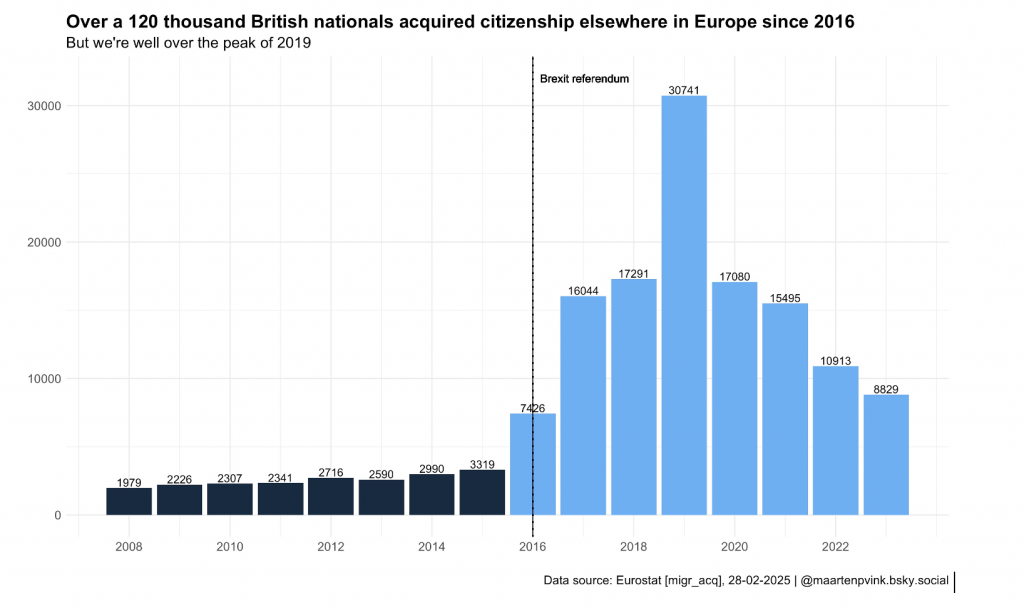
I first look at the main trend in the number of British citizens acquiring citizenship in other European countries, comparing the data reported eight years before 2016 (2008-2015) with the eight years from 2016 onwards (2016-2023). This trend is visualized below. This graphic already offers an early indication of a clear Brexit effect, with the trend breaking in the number of citizenship acquisitions from 2016 onwards.
In the eight years before 2016, on average, 2,710 British citizens acquired citizenship in one of the thirty other European countries studied in the report. By contrast, in the eight years from 2016 onwards, the number of citizenship acquisitions by British citizens in Europe increased to 15,477 on average per year. 2019 was the clear peak year in which over 30 thousand British citizens acquired another European citizenship. In total, 123,819 British citizens acquired a passport of another European country between 2016 and 2023.
Variation by country
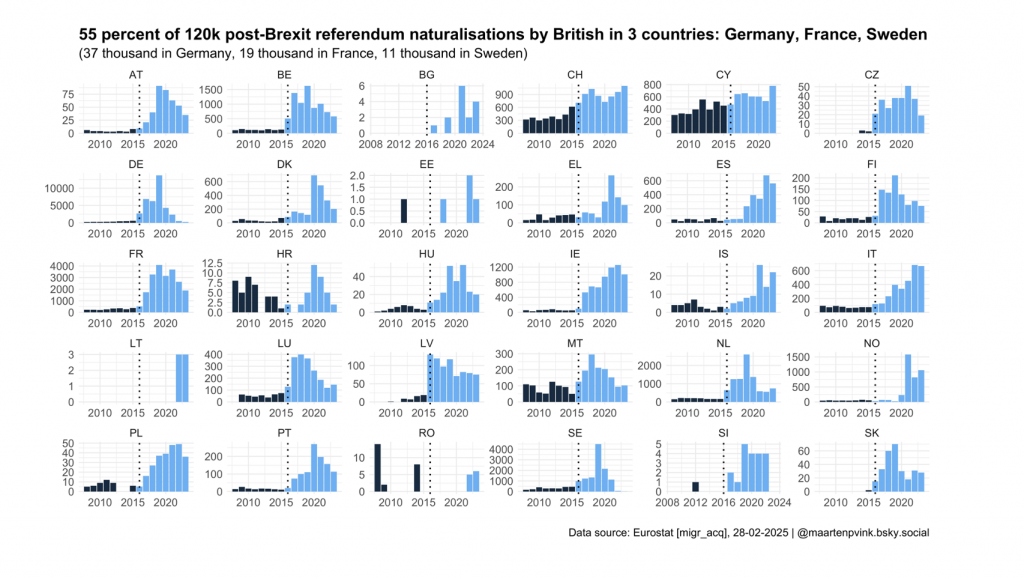
Which countries were British citizens most likely to become a new citizen of in the period after the 2016 referendum? The figure below visualises the main trend in 30 European countries.
This breakdown by citizenship granting country shows that 55 percent of all post-referendum naturalisations took place in three countries: Germany, France, and Sweden. Of these, Germany by far is the country granting citizenship to most British citizens, with up to 37 thousand naturalisations granted from 2016. In France (21 thousand) and Sweden (11 thousand), completing the top 3, the numbers were considerably lower.
Why were post-referendum naturalisations so high in these three countries? Besides population size and the economic attractiveness of these countries (see here, here and here for some studies analysing variations in naturalisation rates in Europe), dual citizenship acceptance is likely an important factor. In France and Sweden, naturalizing immigrants are not required to renounce their previous citizenship, while in Germany, naturalizing EU citizens are exempted from the general renunciation requirement (see here a paper analysing the effect of changing dual citizenship acceptance in Sweden and the Netherlands). By contrast, take-up of naturalisation in, for example, Norway was clearly delayed until it had accepted dual citizenship in 2020; whereas in Austria, only in 2021, take-up of naturalisation by British nationals rose because of new provisions for descendants of Nazi victims which did not restrict dual citizenship (and do not require residency in Austria, though those acquisitions from abroad in principle are not covered by these data from Eurostat).
Estimating the size of the Brexit naturalisation effect
While descriptive trends analysis clearly suggests a Brexit naturalisation effect for British citizens in Europe, in order to identify the causal effect of the Brexit referendum, as well as the substantive effect, we need to compare naturalisations by British citizens with naturalisations by other Europeans. After all, making a statement about causality implies a comparison with a hypothetical control group that is comparable in many ways, but not affected by the ‘treatment’ of the Brexit referendum (again, I refer here to the paper by Auer and Tetlow 2022 who apply a similar strategy).
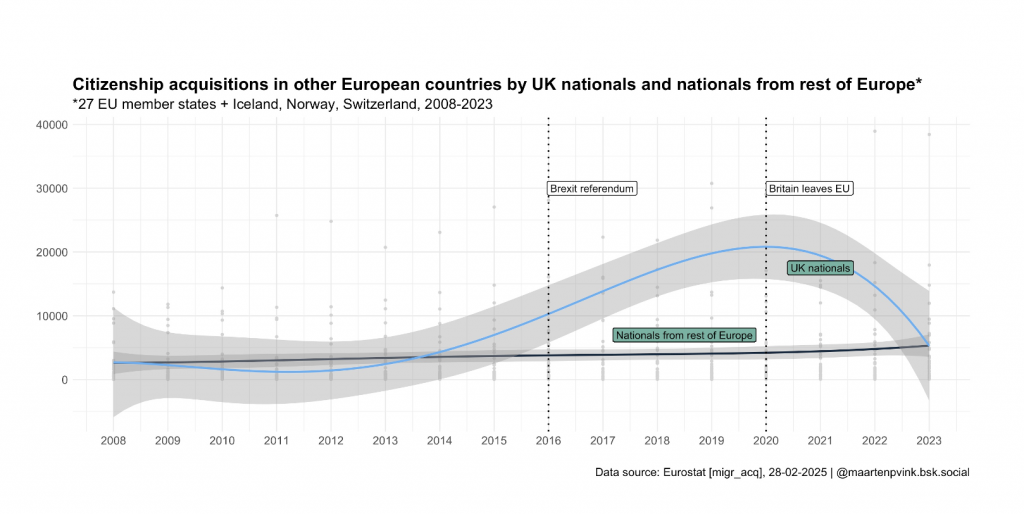
This comparison between the naturalisation trends of the British and the control group of other Europeans is visualized in the figure below. This plot evidences that a) before 2016, the average trends in naturalisations between the two groups were very similar, and b) that from 2015, the trend among other Europeans (the mean trend in naturalisations by citizens of 30 European countries) has continued around the same level, whereas naturalisations among British citizens clearly diverged (note that the plot includes confidence intervals around the so-called polynomial regression lines, which are larger for the trend in British naturalisations as these rely on only one data point for each year). In this figure, we also see a ‘return to mean’ in 2023, which means that eight years after the Brexit referendum, naturalisations by British nationals in other European countries have returned to what can be expected on the basis of the overall European trend over time.
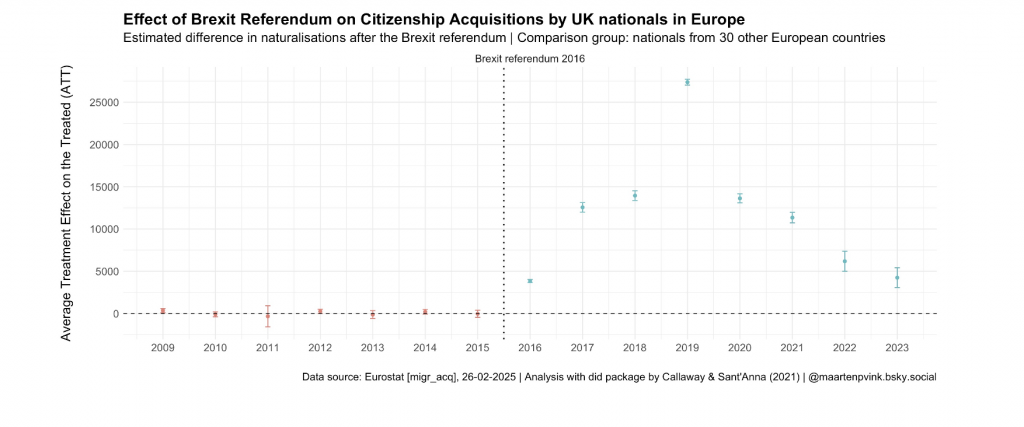
In a final step of the analysis, we can now systematize this comparison in a so-called difference-in-differences (DiD) analysis, which statistically estimates the difference in naturalisations among the treatment group (British citizens) contrasting trends before and from 2016, compared with the same before/after difference among citizens from the control group (other Europeans). I make use here of the DiD approach (and the corresponding R package) developed by Callaway and Sant’Anna.
The event study plot below visualises the results of the DiD analysis. First, the plot visually confirms that we do not have evidence to reject the so-called ‘parallel trend assumption’, which is crucial in DiD analyses: there are no statistical differences between British nationals and other Europeans in the trend before treatment starts, i.e. before the Brexit referendum. Second, from 2016, the trends in naturalisations between British nationals and other Europeans diverge with a clear peak in 2019. Third, the estimated average treatment effect on the treated (ATT) is 11,643 (with a 95% confidence interval of 11,301 – 11,985). This means that – given the trend before 2016 among British citizens and the trend from 2016 among other Europeans – in the eight years since the 2016 Brexit referendum, well over 90 thousand (8 * 11.301 = 93,144) British citizens acquired the citizenship of another European country and likely would not have done so, had it not been for Brexit.
Conclusion
With the exit of the UK from the EU on 31 January 2020, the number of EU citizens diminished by about 60 million British nationals resident in the UK (here, minus those who already held another EU citizenship) and an unknown number of ‘mono’ British nationals residing outside the UK. My analysis shows how over 90 thousand British citizens compensated for the loss of rights due to Brexit by acquiring the citizenship of another EU or associated state. Hence, the EU lost many European citizens with Brexit, but also gained others.
I would highlight three broader implications of these findings. First, the perceived value of EU citizenship (and thus the costs of losing it) is reflected in the almost immediate action taken by British citizens in the wake of the June 2016 referendum, three-and-a-half years before the UK would eventually leave the EU, to acquire the citizenship of another EU or associated state and thus availing the mobility rights that come with EU citizenship. Second, the post-Brexit referendum naturalisation dynamics highlight how Yossi Harpaz’ argument about compensatory citizenship, plays out even with the overall privileged position of the UK within the ‘global citizenship hierarchy’. While maintaining a globally highly valuable UK citizenship, the loss of mobility rights within Europe clearly motivated compensatory action by those with access to another European citizenship. Third, while there was an unmistakable Brexit naturalisation effect, the available numbers also show that only a fraction of those deprived from their EU citizenship managed to compensate for this potential loss of rights. As mentioned above, in addition to the estimates based on Eurostat, we can also look at those who managed to apply for Irish citizenship based on descent. Combining these numbers, we can provide a lower bound estimate of over 210 thousand British nationals who have acquired citizenship of an EU or associated country. Since we know from the literature on naturalisation dynamics that better-educated persons are generally more likely to naturalise, especially under increasingly stricter naturalisation requirements (as explained here), it is worth bearing in mind that the Brexit naturalisation effect is likely to reproduce and reinforce existing inequalities.
Methodological note
Eurostat provides aggregate data on the number of persons acquiring citizenship in all reporting countries in the calendar year in which the acquisition of citizenship occurred (‘migr_acq’). Available data is broken down by age, sex, and former citizenship and refers to the ‘usually resident population’ (see here for more detailed metadata). For this analysis, I use data on the total population and do not restrict by age or sex. I use data on the acquisition of citizenship reported by 27 EU member states and in three associated countries, namely, Iceland, Norway, and Switzerland. I compare the trends in citizenship by citizens of these 30 countries, on the one hand, with the trend among British citizens, on the other.
The Eurostat data can be accessed through Eurostat’s online database, or, for those using R, they can be directly imported into R (see here a very useful explanation by David Reichel, whose code I built on to prepare the analyses for this blog post). The plots and analysis from this post can be replicated with the replication code here.