
Thomas McGee (European University Institute)
With hundreds of thousands of Syrian Kurds having been deprived of citizenship since the 1960s, recent acknowledgement of their suffering by the current Syrian authorities is welcome. The context in which this took place, however, has left many Kurds feeling conflicted and critical about the unprecedented initiative. Situating historic experiences of statelessness and their continued legacy within a transitional justice framework in any meaningful way will require concerted, good-faith trust-building with this long-marginalised constituency.
“Kurds should be happy now, I guess?” This is a question I recently received from an international colleague working on Syria. It came in reaction to the issuance of a decree by Syria’s interim President Ahmed al-Sharaa (previously known as Abu Mohammad al-Jolani) to recognise Kurdish cultural rights and address the historic statelessness affecting part of the Kurdish community deprived of citizenship since the early 1960s. Undoubtedly, this Decree (No 13 passed on 16 January 2026) is unprecedented in the history of Syria, where under the Assad regime (from 1970 to December 2024) law was more commonly used to prohibit Kurdish identity. That said, the context of the recent Decree’s issuance – against a backdrop of several military campaigns launched by the post-Assad authorities targeting Kurdish-held territories in northern Syria – has negatively shaped its reception.
Having worked on the topic of statelessness for the Kurds in Syria as a researcher for well over a decade, I – like many of Syria’s Kurdish community themselves – found myself feeling conflicted. Only one month earlier, I had shared with media my concerns that by neglecting these very same issues, the Syrian government had “failed to take advantage of certain opportunities to show good faith” in building confidence with Kurds. Indeed, the Decree’s reception would no doubt have been significantly different had it been issued at an earlier point in the Syrian transitional government’s time in power, and in the context of peaceful negotiations with the de facto Kurdish authorities that have governed large swathes of Syrian territory for years. Instead, the government’s almost near silence on Kurdish rights and inclusion for a full year in office prior to its recent escalations in Kurdish-held territories has allowed scepticism to grow among Kurdish quarters.
Origins of Kurdish Statelessness in Syria
Kurdish statelessness in Syria is not a new phenomenon. In fact, the origins of the issue predate the Assad-led Baathist regime that ruled the country from 1970 to 2025. The major event causing Kurdish statelessness in Syria was a 1962 “exceptional” census in Hassakeh governorate. This area in northeastern Syria has been home to the majority of the country’s Kurdish community, and borders Kurdish-populated territories in Iraq and Turkey. The 1962 census was mandated by Legislative Decree No. 93, issued by the national authorities at a time of political volatility following Syria’s split from Egypt under the United Arab Republic and amid paranoia about Kurdish challenges against the fragile state. The motivations behind the census were clearly discriminatory, with the purpose to disenfranchise Kurds in this strategically important, resource-rich part of the country. Carried out in a single-day without wide-spread popular awareness, the census resulted in rendering some 120,000 Kurds stateless, and often arbitrarily designated siblings within the same family with different legal statuses. Ultimately, this exercise separated Kurdish inhabitants of Hassakeh into three distinct categories: i) citizens when the census committee was satisfied by evidence attesting to presence in the areas prior to 1945; ii) ajanib (so-called “foreigners”) when the committee was unconvinced by the evidence presented; and iii) maktumeen – those completely unregistered having been missed entirely by the committee on the census day. Both ajanib and maktumeen were denied Syrian citizenship, with the latter facing even harsher restrictions and rights deprivations.
It is important to note that Syria’s Nationality Law (introduced by Legislative Decree 276 of 1969), which has remained in place until today, makes no note of the census, its resulting statelessness, nor the categories of ajanib and maktumeen. Significantly, the safeguard against childhood statelessness contained within Syria’s Nationality Law (Article 3d) has also never been applied to the children of stateless Kurds. Instead, the children of stateless Kurdish parents whose marriages could not be recognised also became maktumeen, resulting in situations of multi-generational Kurdish statelessness in parallel — and in exception — to Syria’s nationality regime. Thus, the number of Kurds from Hassakeh affected by statelessness multiplied over the decades, with one NGO estimating the figure to have reached over 500,000 by 2011.
Regulation by Exceptional Presidential Decrees: Assad’s in 2011 and Sharaa’s in 2026
This year’s Presidential Decree is the second in recent history to address Kurdish statelessness in Syria. Following years of the regime’s broken promises to do so, as the Arab Spring protest movement was reaching Syria in 2011, Assad suddenly issued an exceptional Presidential Decree (No. 49 of 7 April 2011) to “grant Syrian Arab citizenship to the ajanib of Hassakeh”. While, this resulted in access to citizenship for thousands of formerly stateless Kurds, representing the largest single reduction of statelessness in the world for that year, the maktumeen category of stateless Kurds were not mentioned by the naturalisation Decree. Further, the Kurdish community largely viewed this initiative with cynicism as little more than a tactical, and concessionary, measure by the Syrian government seeking to survive novel political dissent. The text of the Decree was little more than a bare sentence describing the “granting” of citizenship and made no acknowledgement of the past deprivation or historical wrong perpetuated against stateless Kurds. As such, many Kurds protested in the streets with banners reading: “we want freedom, not citizenship”. In arguing that this gesture by the Syrian government and its associated discourse were inadequate to address the historic legacy arising from depriving Kurds of Syrian citizenship, statelessness scholar Haqqi Bahram advocated for a transitional justice framework to be employed to the issue long before the fall of the Assad government.
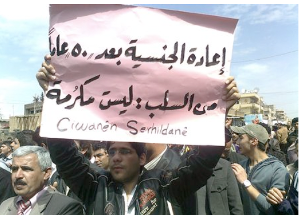
Following the December 2025 regime change, Kurdish civil society actors and individuals themselves affected by statelessness in Hassakeh governorate mobilised calling for attention to the plight caused by the 1962 census. This culminated in the October 2025 founding of the Network of Statelessness Victims in al-Hasakah (NSVH): “an independent, victim-led initiative providing an inclusive framework for coordination, solidarity, and advocacy for the right to nationality and legal recognition.” This group has proved instrumental in providing targeted commentary on the issue as it has developed over the last half year.
In comparison to Assad’s Decree No. 49 of 2011, the textual provisions of Decree No. 13 issued by President Sharaa in January 2025 are certainly more substantial. Article 4 of the latter states that “All exceptional laws and measures resulting from the 1962 census in Al‑Hasakah province are annulled” and that “Syrian citizenship is granted to all residents of Kurdish origin living in Syria, including those previously unregistered, with full equality in rights and duties.” It is positive that the historical context of the 1962 census is clearly referenced and that there is acknowledgement of the “exceptional” treatment of stateless Kurds – neither of which featured in Decree No. 49 of 2011. However, the fact that each Decree was passed in the context of political urgency for the relevant state authorities has led to perceptions that citizenship issues are being instrumentalised as part of political management. The passing of Decree No. 13 may be seen as a means to counter negative public opinion given the state’s recent aggression against Kurds, leaving members of the community to consider that their cultural and citizenship recognition are being treated as a tactical issue rather than as innate rights – a dynamic echoing Decree No. 49 of 2011.
Decree No. 13 – Unprecedented, But Again Too Little Too Late?
Decree No. 13 is undoubtedly unprecedented for its legal recognition of Kurdish rights. Prior to its issuance, the Constitutional Declaration Syria had adopted in March 2025 assertively “guarantee[d] the cultural diversity of Syrian society in all its components, and the cultural and linguistic rights of all Syrians”, but made no explicit reference to the status of the Kurdish language or the cancellation of various measures that have historically prohibited its use. Likewise, Kurdish New Year (Newroz) had been omitted in the list of public holidays previously announced in October 2025. The inclusion of explicit references to both Kurdish language and Newroz in Decree No. 13 is, therefore, significant. While Decree No. 13 has been celebrated as a “foundational step” in some camps, and framed by State Council President, Judge Abdul Razzaq Kaadi, as boosting rule of law, many Kurds have received the measure with less jubilation.
Just as some have criticised the official recognition of the Kurdish language for only securing two hours a week of optional Kurdish-language education in some regions, there is also critical commentary about the Decree’s provisions specific to statelessness, with actors arguing that it falls short legally as well as politically. For instance, a statement by the above-mentioned Network (NSVH) notes that the Decree’s “wording remains insufficient to address the structural and systemic roots of statelessness in al-Hasakah,” adding that the “events of 1962 did not constitute an administrative mistake, but rather a deliberate and systematic violation of a fundamental human right.” They thus take issue with the term “granting” nationality, calling instead for “restoration of Syrian nationality to its rightful holders who were unjustly deprived of it.” Indeed, Evîn Yûsiv, a member of the NSVH, focused on the preference for the term citizenship “restoration” in her intervention at a March 2026 conference in Damascus. Some have gone as far as to describe the recent Decree as reminiscent of a bad-faith “deception” of the Assad regime towards stateless Kurds.
According to a subsequent decision issued by Syria’s Interior Minister Anas Khattab stipulating the implementing instructions relating to Decree No. 13, applications for maktumeen stateless Kurds to register for Syrian citizenship began on Monday 6 April 2026 and will remain open for a month, with possible extension if deemed necessary. While it is welcome that these implementing instructions have been published (in contrast to those relating to Decree 49 of 2011, which were never transparently shared), some concerns have been reported about implementation conditions during the first week of applications. For instance, based on its efforts to disseminate information about the application process to affected community members and to monitor the five registration centres operating across Hassakeh governorate, the NSVH reported recurrent cases of individual maktumeen being registered as ”Syrian Arab” on the application form – a problematic and inaccurate designation for Kurds and other ethnically non-Arab communities in Syria. It should be noted that while the term “Syrian Arab” does not feature in the more neutral language of Decree No. 13 (and the associated implementing instructions simply refer to “Syrian nationality”), the 1969 Nationality Law defines Syria’s citizens in prescriptively ethno-nationalist terms as a remnant of exclusionary pan-Arabist ideology. Furthermore, as yet there is no established mechanism for, or clear information regarding, the application for stateless Kurdish maktumeen currently residing outside Syria.
Situating Kurdish Statelessness in the Broader Transitional Justice Framework
Within the debates about the value and significance of Decree No. 13, a notable stream of thought suggests that it is a necessary, if on its own insufficient, action to addressing the legacy of Kurdish statelessness. A Presidential Decree is the highest possible form of recognition of the issue during the current transitional process given the suspension of the previous constitution and that the newly formed Syrian parliament is still not activated. That said, legal analysts have rightly noted that this does not have the same standing and level of commitment as constitutional recognition. Further (legislative) reform is, therefore, needed to ensure the current “partial” resolution of Kurdish statelessness is more fundamentally embedded in the transitional justice framework and state-building processes. While – as one former judge has noted – Decree No. 13 is sufficient to give the Ministry of Interior a legal mandate to implement the “return” of Syrian citizenship to affected stateless Kurds, it is essential that the Decree’s core provisions be worked into the future Syrian constitution and a reformed Nationality Law, noting that gender discrimination in the latter also remains unaddressed. Here, perhaps an important model is the 2006 reformed Iraqi Nationality Law, which makes explicit reference to citizenship “restoration” for Iraqis deprived through “unfair” decisions (Articles 17-18).
Additionally, while recognition of Kurdish statelessness is a first step to addressing the long-standing discrimination and exclusion of Kurds in Syria, it will be necessary to more fundamentally address the implications of the 1962 census within a Transitional Justice framework – covering issues of reparations, truth-seeking and guarantees against non-recurrence. Notably, civil society activists have called on the National Commission for Transitional Justice to take an expansive approach to its mandate to investigate “grave violations caused by the former regime”, by not neglecting harms inherited and never comprehensively addressed by the Assad regime. Given the legacy of eroded trust among stateless maktumeen, and wider Kurdish community produced by the Assad regime’s bad-faith use of law, it is essential that Decree No. 13 translates into meaningful implementation, while also integrating its provisions into more comprehensive legislative protections and Syria’s transitional justice framework.