2018: a year in citizenship

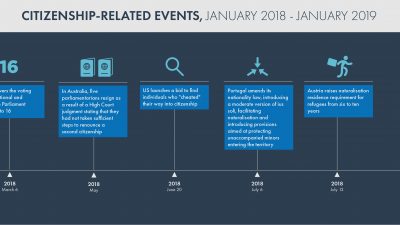
Throughout 2018, citizenship has been one of the most ubiquitous topics of political debate in a number of countries. In January the Austrian and the Italian governments entered into a spat over the possibility to offer Austrian citizenship to German and Ladin speaking people living in the region of South Tyrol. In May the United Kingdom government was embroiled in a scandal over the rights of Commonwealth citizens who arrived in the UK in the period after the Second World War. And in October, the US President Donald Trump said he will try to end the right to U.S. citizenship for babies born in the United States to non-citizens. While being a burning topic in the political discourse, the way countries regulate their membership has remained largely intact. In fact, there have been only a few changes to citizenship legislation between January 2018 and January 2019. We have mapped these reforms. Read More …

Videos

Book presentation: Migration & Staatsbürgerschaft The curious case of Austria’s citizenship policy   Are There Any Cultural Majority Rights? CEU Lecture 22 February 2021   Rainer Bauböck: Teilhabe und Einbürgerung in der städtischen Migrationsgesellschaft Rainer Bauböck: Toleration of Dual Citizenship Read More …

The local citizenship crisis in Switzerland

Swiss municipalities face what can be called a local citizenship crisis. They struggle to recruit people, especially young ones, who want to hold public office – even though according to a new study one in five young citizens would be ready to be engaged in local politics. Among the proposed remedies are the introduction of candidacy rights for non-citizens as well as for citizens not residing in the municipality. The proposals highlight the strongly republican character of citizenship in Switzerland. Read More …

Investor citizenship and refusal as political practice of states and non-citizens

In the context of citizenship, ‘refusal’ can have both a state dimension and an individual one. It creates populations whose rights are limited domestically or internationally, either through their own volition or by deliberate state action. While in these cases investor citizenship can indeed serve the instrumental purpose of attributing a status it remains a highly problematic practice. Read More …