
‘Borderland Citizenship’ Could Bring Justice to Both Sides of Trump’s Wall
Border dwellers in the US and Mexico are subject to two authorities. It’s only fair to give them the cross-border rights and permissions to match.
Over 15 million citizens of the European Union (EU) are currently living in a Member State other than that of their nationality. While in theory they should be accorded the same electoral rights as nationals of the Member State where they reside, the reality is far more complicated. Member States have wide discretion in regulating voting and candidacy rights of mobile EU citizens. Read More …
As the number of returning foreign fighters increases after the downfall of the Islamic State (IS), the practice of an increasing number of European states to deprive these persons of their citizenship and their right to return continues to be the subject of public discourse and scholarly debate. In the Netherlands, where those who join certain terrorist organisations abroad can lose their citizenship since the enactment of the necessary legislation in March 2017, the practice remains controversial. Read More …
The electoral franchise has become more universal as restrictions based on criteria such as sex or property have been lifted throughout the process of democratisation. Yet, a broad range of exclusions has persisted to this date, making the suffrage non-universal, even in established democracies. In this article, we present ELECLAW, a new set of indicators that captures the subtle and variegated legal landscape of persisting electoral rights restrictions. Read More …
Shamima Begum’s case prompts larger questions: does stripping someone of citizenship, or more broadly denying someone access to citizenship, lead to justice and security? What do we actually know about how citizenship-stripping and denying access to citizenship affect both the people as well as the countries in question? Read More …
Tjebbes is a bold and yet thoughtful judgment. It pushes the boundaries of the role of EU law in nationality matters and yet does so in a manner that both respects the primacy of the Member States in regulating this area of law, and acknowledges the genuine Union-interest in the manner in which denaturalisation decisions impact on Union citizens. It provides a follow-up and elaboration of the judgment in Rottmann, confirming the applicability of Union law in nationality law and detailing the nature of its intervention. This intervention is of both a procedural and a substantive kind, requiring an individual examination of any decision withdrawing nationality having regard to a set of consequences linked to the status of Union citizenship. Read More …
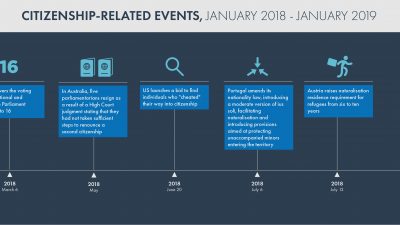
Throughout 2018, citizenship has been one of the most ubiquitous topics of political debate in a number of countries. In January the Austrian and the Italian governments entered into a spat over the possibility to offer Austrian citizenship to German and Ladin speaking people living in the region of South Tyrol. In May the United Kingdom government was embroiled in a scandal over the rights of Commonwealth citizens who arrived in the UK in the period after the Second World War. And in October, the US President Donald Trump said he will try to end the right to U.S. citizenship for babies born in the United States to non-citizens. While being a burning topic in the political discourse, the way countries regulate their membership has remained largely intact. In fact, there have been only a few changes to citizenship legislation between January 2018 and January 2019. We have mapped these reforms. Read More …
Swiss municipalities face what can be called a local citizenship crisis. They struggle to recruit people, especially young ones, who want to hold public office – even though according to a new study one in five young citizens would be ready to be engaged in local politics. Among the proposed remedies are the introduction of candidacy rights for non-citizens as well as for citizens not residing in the municipality. The proposals highlight the strongly republican character of citizenship in Switzerland. Read More …
In the context of citizenship, ‘refusal’ can have both a state dimension and an individual one. It creates populations whose rights are limited domestically or internationally, either through their own volition or by deliberate state action. While in these cases investor citizenship can indeed serve the instrumental purpose of attributing a status it remains a highly problematic practice. Read More …
Since 2008, the archives of the Conseil constitutionnel (the French constitutional court) must be disclosed after a period of twenty-five years. The centre-piece of these archives is the verbatim of the judges’ deliberation. The recent release of the deliberations of the major decision of 20 July 1993 shows new aspects about nationality law in France. Notably, some of these (no longer) secret discussions of the judges suggest that ius soli, while currently only included in ordinary law, could also become an unwritten constitutional principle. Read More …